
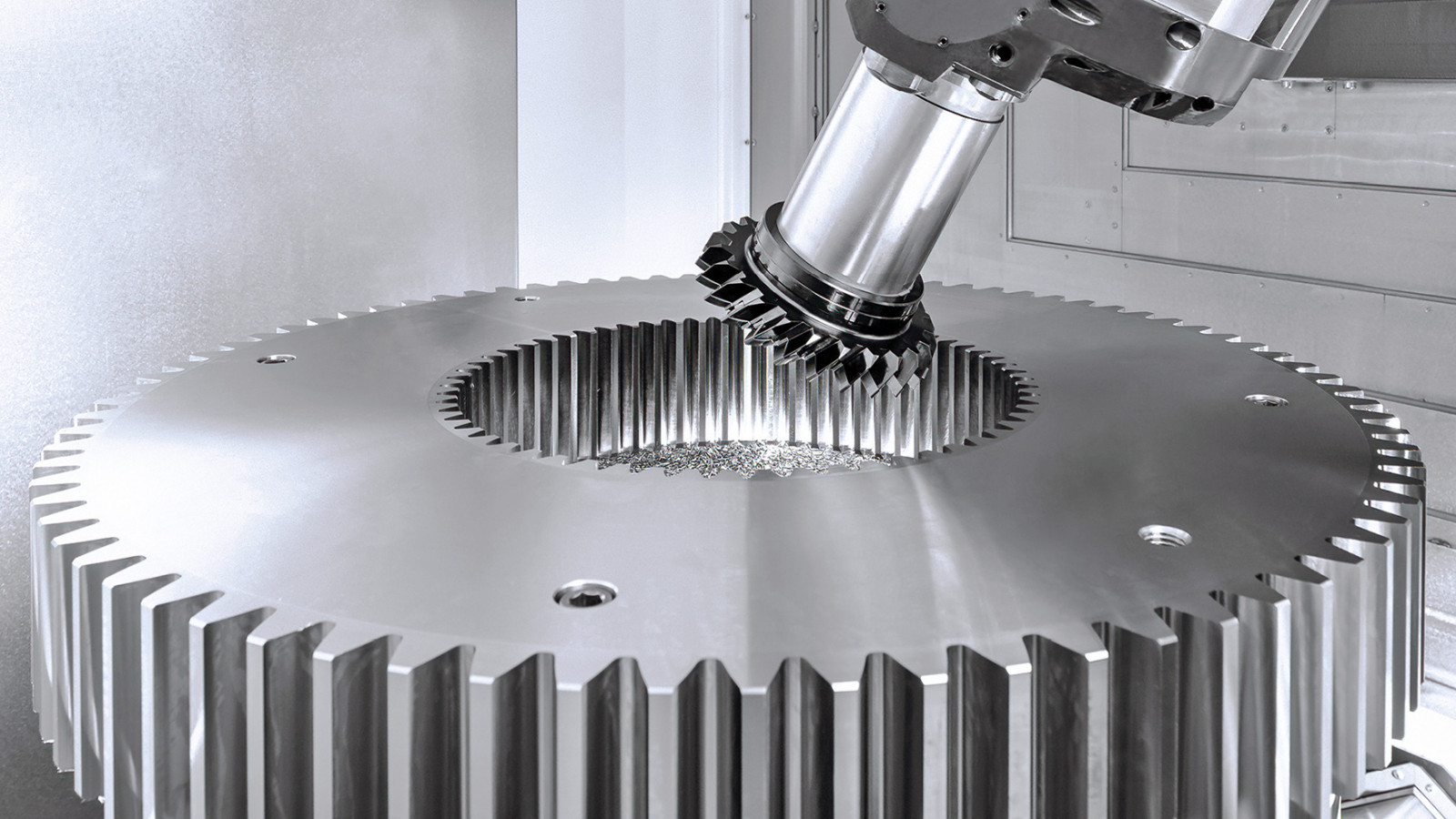
One of the themes on the DMG MORI stands at both the IMTS exhibition in Chicago and the AMB trade fair in Stuttgart in September this year will be software for the economical machining of gears, aimed primarily at small to medium size manufacturing companies.
The machine tool manufacturer’s gearMILL software, along with the gearBROACHING, gearSHAPING, gearHOBBING and gearSKIVING technology cycles, enable gear cutting operations on appropriately equipped, standard machining centres and turn-mill centres. The conversational software packages facilitate the programming and execution of gear cutting processes, making it easier to get started with cost-effective production without special-purpose machines.
Job shops and contract manufacturers are able to take advantage of new opportunities without having to outsource gear cutting orders, thereby reducing administrative effort, shortening lead times, cutting costs and ensuring faster delivery times. The benefits go even further, as there are more possibilities for seamlessly expanding complete machining into integrated turning, milling, gear cutting and measuring.
Compatibility with standard tools
DMG MORI gearMILL is not a technology cycle in the strict sense, but rather software for producing complex gear geometries that makes it easy to implement custom profile and flank modifications. It also facilitates adapting load patterns to meet customer requirements. The integrated CAM module then ensures efficient programming for machining using standard tools. The achievable gear quality of ≥ 5 according to DIN/ISO easily meets the requirements for prototypes, spare parts and small production runs across various industries.
Recurring gear cutting
As soon as specific gear geometries are produced on a regular basis, it is worth making the switch to process-specific cycles. gearSKIVING 2.0 enables up to eight times faster machining than conventional hobbing and enables the production of internal and external gears up to module 11 with a quality grade of ≥ 7. On DMG MORI turn-mill centers in the NTX and CTX TC series, this also applies to helical gears with tooth offset.
The gearHOBBING technology cycle covers the need to hob external spur and helical gears, while gearBROACHING is designed for broaching internal and external gear teeth up to module 4 by synchronising the linear cutting stroke with the rotational position of the spindle. Finally, gearSHAPING supports the production of internal or external gear teeth using the gear shaping method. All cycles are available as software retrofits for existing machines.
Integrated Measurement
A major factor in boosting productivity is in-process optical measurement of gear teeth using a laser scanner. With 70,000 scan points per second and more than 80 percent of the measured points within ±2 µm, DMG MORI’s gearQUALITY solution achieves accuracy equivalent to that of an external CMM (coordinate measuring machine).
Compared to a conventional gear manufacturing method involving roughing on a lathe or mill, gear cutting on a specialised machine, a visit to a CMM for measurement of gear geometry and perhaps return to the gear cutting machine for finishing, the number of process steps is reduced typically from ten to six and total processing time is cut by more than half. As machining and metrology take place in a single clamping, correction values are fed back immediately to the control, resulting in quality and logistical advantages, particularly for larger components.
Complete machining in a single setup
On DMG MORI multi-purpose lathes, turning, milling, gear cutting and measuring can all be performed in a single setup, added to which complete six-sided machining can be achieved without re-clamping. This in turn creates optimal conditions for the cost-effective addition of standard autonomous solutions, such as the Robo2Go robotic automation system. Even small and medium size service providers can benefit from more predictable production flow, less handling and work-in-progress, and shorter delivery lead-times to customers.